
World Cup 2026 Connectivity Guide: How to Stay Online Across USA, Canada & Mexico
The 2026 FIFA World Cup is the first tri-country tournament. Here is exactly how to stay connected without paying roaming fees—across all 16 host cities, from New York to Mexico City.
Published May 1, 2026·Updated May 4, 2026·12 min read
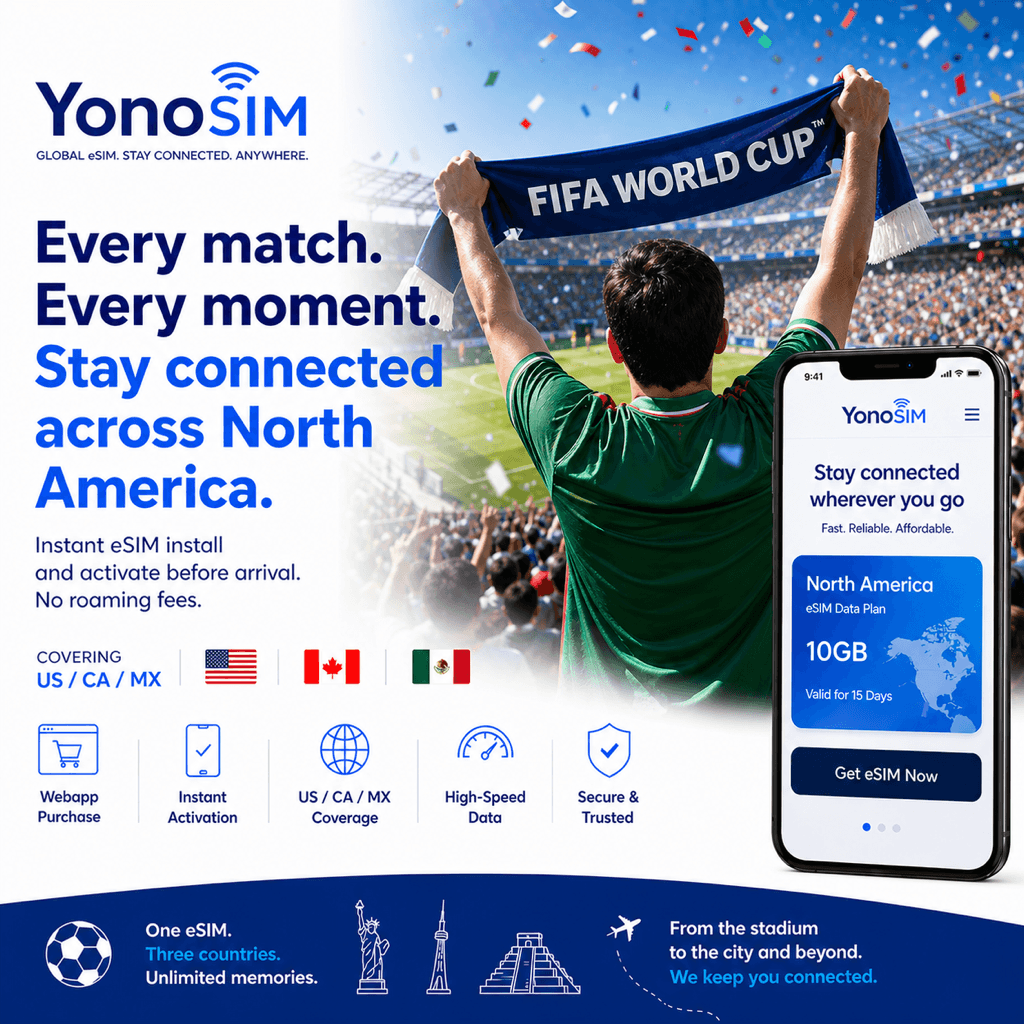
The first World Cup across three countries
For the first time in the tournament's 100-year history, the FIFA World Cup will be played across three host nations: the United States, Canada, and Mexico. Sixteen host cities. Forty-eight teams. Over a hundred matches. And for fans following their team, a logistical reality every prior World Cup spared us: international border crossings, mid-tournament.
Argentina vs. Mexico in Los Angeles, then a quarter-final in Toronto, then the semis in Dallas? That's three SIM cards under the old playbook. This guide is about not living that life. We'll cover what your phone actually does when you cross from the USA into Canada or Mexico, why the 2026 tournament is the worst possible event to test your carrier's “international roaming” passes against, and how a single eSIM keeps you online from the opening match in Mexico City to the final at MetLife.
Why connectivity is harder than you think
The host cities span an absurd geographic spread—roughly 4,400 km from Vancouver to Miami, and another 1,500 km south to Mexico City. Most fan itineraries we've seen so far follow one of three patterns:
- Single-country group stage, multi-country knockouts.You watch your team's group stage in (say) Dallas and Houston, then hop to Toronto when they advance. One country becomes two.
- Triangle tour.A bucket-list itinerary: a match in each host country. Mexico City → New York → Toronto, in that rough order, is increasingly common.
- Border-state base. Fans staying in (e.g.) San Diego while attending matches in Tijuana-region cities, or Buffalo-area fans crossing for Toronto matches. Their phones cross the border every match day.
In every one of those patterns, your phone is going to switch countries at least once. And in every one of those patterns, the carrier app on your phone is going to try to monetize that switch.
The roaming math (it's worse than it looks)
Most US, Canadian, and Mexican carriers offer some flavor of an “international day pass” or “travel pass.” They're convenient, but the price-per-day for a multi-week tournament adds up fast:
- US carrier “day passes” for Canada/Mexico: ~$10–12 USD per device per day, often capped at high-speed thresholds before throttling. Two weeks for a couple = ~$300+.
- Canadian carrier US/Mexico passes: Bell, Rogers, and Telus charge in the same $12–15 CAD/day band. Crossing into the US for a match day is essentially $30 for two phones.
- Mexican carriers (Telcel, AT&T MX, Movistar):Some include “Sin Frontera” plans that bundle USA/Canada usage. If you're a local fan traveling north, these can be excellent—if you're visiting from elsewhere, they're irrelevant.
- The hidden cost: speed. Most travel passes throttle to 2G or low-3G after a daily cap. Maps work. Streaming a goal replay does not. Group chats slow to a crawl when a hundred thousand fans hit the network at full-time.
For a typical two-to-three-week tournament trip with one or two border crossings, day passes regularly run $300–$500 per phone—and you're still locked into your home carrier's congestion and throttling rules abroad.
eSIM in 60 seconds (problem → inevitability → product)
An eSIM is a digital SIM card. Your phone already supports it (every iPhone since the XS, Pixel since 3, most recent Samsungs). You buy a data plan online, scan a QR code, and it provisions a second line on your device—without removing or shipping a physical SIM.
For tri-country travel like the 2026 World Cup, the relevant features are:
- Single plan, multi-country coverage. Regional eSIMs cover USA + Canada + Mexico on one prepaid plan. No swap when you cross.
- You keep your home line.Your physical SIM (or primary eSIM) stays as your phone number. The travel eSIM handles data. Texts and calls to your home number still work over Wi-Fi calling or your home carrier's included international texting.
- Pricing is upfront. No surprise daily charges. You pre-pay for X GB over Y days, end of story.
- Activation is digital. Buy the plan in your browser; the QR code is delivered on the order page and by email. Install over Wi-Fi at your hotel. No store visit, no shipping.
The simplest mental model: a travel eSIM is to your phone what an Airbnb is to a hotel chain's nightly rate. Same outcome, drastically better unit economics, slightly more setup the first time.
How much data do you actually need?
Tournament travel hits your data plan harder than a normal trip. Match-day photos, ticket app refreshes, ride-share routing, group chats, and the inevitable highlight clips your friends back home demand—it adds up. Here's a rough breakdown:
- Maps + rideshare:50–150 MB per active day. Higher if you're jumping between neighborhoods on match days.
- Ticket apps + entry QR codes: small but unforgiving. The day a stadium app fails to load is the day you appreciate not being throttled.
- Social media / messaging: 100–600 MB per day depending on how much video you consume in feed.
- Match-day uploads: 200–500 MB per match if you upload clips and photos to your group chat or socials.
- Live streams (if you watch other matches on the road): 1–2 GB per hour for HD; up to 5 GB/hour for 4K. This dominates everything else.
For most fans attending 3–6 matches over 10–14 days without heavy livestreaming, a 10–15 GB regional plan is the sweet spot. If you stream other matches on the move, plan for 20–30 GB. Use the calculator below to estimate yours:
Data usage estimator
A rough estimate of how much mobile data you'll need. Adjust the inputs to match your trip.
Streaming behavior
Social media usage
Maps & rideshare
Countries you'll visit
Recommended
7 GB
Suggested plan size: Medium. Includes a 20% safety buffer over your estimated usage (5.4 GB raw).
Why this number?
- Base browsing: 2.1 GB
- Match-day surge: 0.8 GB
- Social media: 2.1 GB
- Maps & rideshare: 0.4 GB
- + 20% safety buffer
Estimates only. Actual usage depends on your apps and how often you stream high-resolution video.
Coverage notes for USA, Canada, and Mexico
United States
The big three—Verizon, T-Mobile, and AT&T—run dense LTE/5G networks across all 11 US host cities. Stadium-area coverage is generally excellent because every host venue gets crowd-aware booster deployments for major events. Travel eSIMs roam onto these same networks, so the in-stadium experience is comparable to what a Verizon or T-Mobile customer gets.
Canada
Toronto and Vancouver are the two Canadian host cities. Bell, Rogers, and Telus all run dense networks downtown and at both stadium areas (BMO Field and BC Place). Travel eSIMs that include Canada partner with one of these carriers under the hood—coverage is essentially identical.
Mexico
Mexico City, Guadalajara, and Monterrey are the host cities. Telcel has by far the broadest network and is the partner most travel eSIMs use. AT&T Mexico is a strong second option in major metropolitan areas. Coverage at all three host stadiums is solid; coverage outside the metro areas (e.g. day trips) varies more than in the US or Canada.
Pick your trip
We've published city-specific guides for the four highest-traffic host cities so far—stadium notes, transit tips, and the coverage details that actually matter on match day:
- New York / New Jersey — MetLife Stadium: MetLife Stadium hosts a heavy slate of World Cup 2026 matches—including a knockout round. Expect the largest North American crowds of the tournament here.
- Los Angeles — SoFi Stadium: SoFi Stadium delivers some of the marquee group-stage and knockout matches. Pair it with a couple of California beach days for a full Pacific-coast trip.
- Mexico City — Estadio Azteca: Estadio Azteca is the only stadium to host three World Cups—an absolute pilgrimage match for any soccer fan visiting Mexico in 2026.
- Toronto — BMO Field: BMO Field hosts a slice of group-stage matches plus Canada's home games. A natural extension if you're already in the eastern US for matches.
- Atlanta — Mercedes-Benz Stadium: Atlanta is a marquee 2026 host with eight matches culminating in a semifinal under the retractable roof.
- Boston — Gillette Stadium: Boston/Foxborough hosts seven matches including a quarterfinal on July 9, 2026.
- Dallas — AT&T Stadium: Dallas hosts the most matches of any 2026 venue (nine), headlined by a semifinal.
- Houston — NRG Stadium: Houston hosts seven matches including a Round of 32 and Round of 16 clash under the retractable roof.
- Kansas City — Arrowhead Stadium: Kansas City hosts six matches including a quarterfinal on July 11, 2026.
- Miami — Hard Rock Stadium: Miami hosts seven matches including the July 18 third-place playoff.
- Philadelphia — Lincoln Financial Field: Philadelphia hosts six matches including a Round of 16 clash on July 4, 2026.
- San Francisco Bay Area — Levi's Stadium: The Bay Area hosts six matches at Levi's Stadium, including a Round of 32 fixture on July 1.
- Seattle — Lumen Field: Seattle hosts six matches at Lumen Field including a Round of 16 fixture.
- Vancouver — BC Place: Vancouver hosts seven matches at BC Place, including Canada's home group-stage games and a Round of 16 fixture.
- Guadalajara — Estadio Akron: Guadalajara hosts four group-stage matches including a Mexico fixture on June 18.
- Monterrey — Estadio BBVA: Monterrey hosts four matches at Estadio BBVA, including a Round of 32 knockout fixture.
More host city pages (Boston, Dallas, Miami, Seattle, Atlanta, Houston, Kansas City, Philadelphia, San Francisco, Vancouver, Guadalajara, Monterrey) are publishing on a rolling schedule.
Frequently asked questions
Do I need a separate eSIM for each host country?
No. Regional eSIMs that cover USA + Canada + Mexico exist and are exactly what you want. You buy one plan, install one QR code, and it works across all three countries with no manual switching.
Will my phone number still work?
Yes. Your home SIM (or primary eSIM) stays active for calls and texts. The travel eSIM is a second data line. iMessage, WhatsApp, FaceTime, and Wi-Fi calling all keep working as expected.
When should I install the eSIM?
Most plans let you install ahead of time but only start the validity window when you first connect in-country. Check the specific plan's rules—we surface activation timing on every plan's detail page before you buy.
Will my phone work with an eSIM?
Probably yes. Every iPhone XS or later, Pixel 3 or later, Galaxy S20 series and most recent Samsung/Motorola/OnePlus phones support eSIM. If you bought your phone after 2020 and it's carrier-unlocked, you're almost certainly fine. The constraint is hardware + the unlock state of your phone, not the eSIM provider.
What if I run out of data mid-tournament?
Top-up the same plan, or buy a fresh one. We surface top-up options on the order page after purchase so you don't have to re-install anything.
How much do I save versus a carrier roaming pass?
For a two-week, two-country trip, our regional World Cup plans typically save fans $200–$400 per phone versus a US, Canadian, or Mexican carrier's daily roaming pass at the same data volume.
Will it work in the stadium?
Yes. Travel eSIMs roam onto the same major carriers (Verizon/T-Mobile/AT&T in the US, Bell/ Rogers/Telus in Canada, Telcel/AT&T MX in Mexico) that natively serve the stadium areas. Stadium Wi-Fi is the option that's typically congested—not your eSIM.
Can two of us share one eSIM?
No. eSIMs are per-device. Two phones need two eSIMs. The good news: you can buy two on the same order, get two QR codes, and install one on each phone.
What about my partner's Android / kid's tablet?
Same answer: one eSIM per device. Most modern Android phones and many tablets (iPads since 2018, Pixel tablets, recent Samsung tablets with cellular) support eSIM. Check before you buy if you're unsure.
What about calls/texts to local US/Canadian/Mexican numbers?
Travel eSIMs are typically data-only. For local calls, use WhatsApp, iMessage, or your carrier's Wi-Fi calling over your eSIM's data connection—it works seamlessly across all three countries.
Putting it all together
The 2026 World Cup is a historic tournament for a lot of reasons. The first three-country format. The first 48-team event. The largest single sporting event ever staged in North America. Every part of the infrastructure around it is being stress-tested—including your phone's relationship with your home carrier.
A regional eSIM that covers USA + Canada + Mexico is the single highest-leverage purchase you can make for a tournament trip. Pricing is upfront, coverage is on the same major carriers your home roaming would use, and you keep your normal phone number. It is the boring, obvious move—exactly the kind of preparation that separates a smooth trip from a stressful one.
Our recommended plans for the tournament—a regional USA+CA+MX option plus per-country options for fans staying in a single host nation—are on our World Cup 2026 page. If you'd prefer to browse the full catalog, our plans page has every option including longer-validity bundles for fans staying through the knockouts.
See you across the host cities.