
eSIM vs Local SIM at World Cup 2026: 3 Host Countries, One Profile Wins
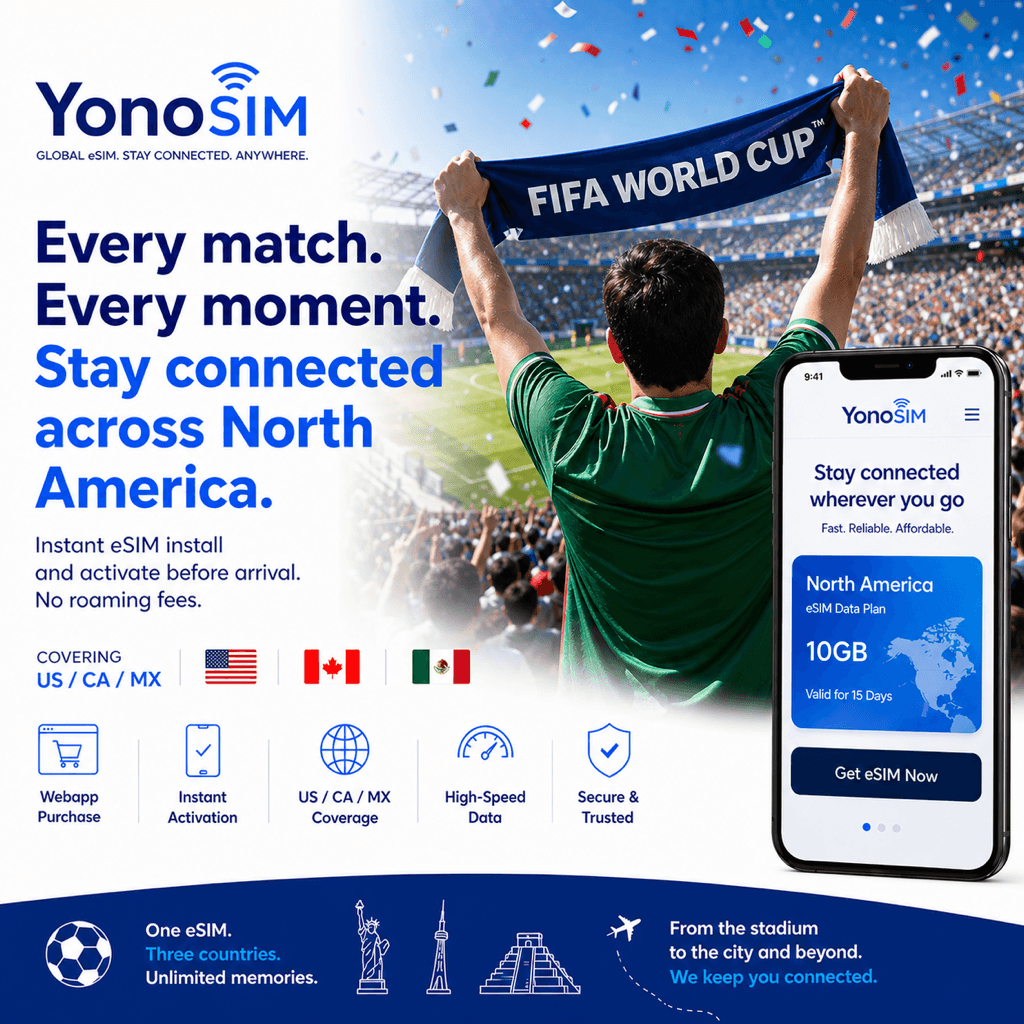
Following the World Cup across the USA, Canada, and Mexico? Local SIMs mean 3 separate purchases, ID registration, and language barriers. One North America eSIM (US$3–30) covers all three on a single profile — no store visits.
Published July 4, 2026·6 min read
Summary
Following the World Cup across all 3 host countries means a local-SIM fan makes 3 separate purchases— T-Mobile/AT&T in the US, Rogers/Bell/Telus in Canada, Telcel/AT&T in Mexico — plus ID registration and Spanish-first menus down south. A single North America travel eSIM (US$3–30) covers all three on one profile, no store visits. The 2026 tournament is in its knockout phase now, with the final on July 19, 2026 at MetLife.
Three countries, three SIM-store trips
World Cup 2026 is shared by the United States, Canada, and Mexico, and once the Round of 16 gives way to the quarterfinals and semifinals, fans chase fixtures across borders on short notice. Buy local SIMs and you repeat the same errand three times: a T-Mobileor AT&T SIM in the US, a Rogers (or Bell/Telus) SIM in Canada, and a Telcelor AT&T Mexico SIM in Mexico — each a separate queue, a separate top-up, and in Mexico often an ID-registration step in Spanish. A travel eSIM collapses all of that into one profile you install before you fly.
The 3 host countries at a glance
| Country | Main carrier | Local-SIM hassle | eSIM verdict |
|---|---|---|---|
| USA | T-Mobile / AT&T | Store visit, passport for prepaid | Same networks, no queue |
| Canada | Rogers / Bell / Telus | Pricier prepaid, second purchase | Covered on the same profile |
| Mexico | Telcel / AT&T | ID registration, Spanish-first | Skip registration entirely |
eSIM vs roaming vs pocket Wi-Fi
| Option | Cost | Setup time | Coverage |
|---|---|---|---|
| eSIM | Low (US$3–30, one profile) | ~5 min (pre-install on Wi-Fi) | Excellent (all 3 countries) |
| 3× local SIMs | Medium (buy 3 times) | 3 store visits + registration | Good, but swap at each border |
| Pocket Wi-Fi | Medium | Airport pickup / rental | Good (extra device to charge) |
How much data a tri-country run needs
Budget about 1–1.5 GB per match day for maps, ride-hailing, the FIFA app, ticket wallet, and photo uploads. A one-city fan can get by on a small US$3–8 plan, but anyone hopping between US, Canadian, and Mexican host cities during the knockouts should size up to 10 GB or unlimited (up to ~US$30). Because a North America eSIM rides the same T-Mobile, Rogers, and Telcel networks a local SIM would, coverage is comparable — you just skip three checkout counters. See the full lineup on YonoSIM's North America plans.
FAQ
QDo I need 3 separate SIM cards for the USA, Canada, and Mexico?
ANo. Buying local SIMs means three separate store visits — T-Mobile or AT&T in the US, Rogers/Bell/Telus in Canada, and Telcel or AT&T in Mexico — often with ID registration in Mexico. A single North America travel eSIM covers all three countries on one profile, so you install once and cross borders without swapping cards.
QHow much data do I need following matches across host countries?
APlan on 1–1.5 GB per match day for maps, ride-hailing, the FIFA app, and ticket wallet. A one-city fan is fine with a small plan, but multi-city fans chasing the knockouts should pick 10 GB or unlimited (US$3–30 range depending on size).
QIs registering a local SIM in Mexico a hassle for tourists?
AIt can be. Mexican carriers like Telcel increasingly ask for ID at activation, and menus and support are Spanish-first. A travel eSIM skips registration and store queues entirely — you activate it in English before you fly.
QWhen does the World Cup 2026 knockout stage finish?
AThe tournament is in its knockout phase now — the Round of 16 leads into the quarterfinals and semifinals, with the final at MetLife Stadium (NY/NJ) on July 19, 2026.
Bottom line
For fans following the World Cup across the USA, Canada, and Mexico, three local SIMs mean three purchases, an ID-registration detour in Mexico, and a card swap at every border. One North America travel eSIM — from US$3, up to ~US$30 for unlimited — puts all three host countries on a single profile you install at home. Pay with Apple Pay, Google Pay, or card, and arrive with data already on for the run to the July 19 final.