
World Cup 2026 Money Guide: USD, CAD & Peso Tips
Following the 2026 World Cup across three host countries means juggling three currencies — US dollars, Canadian dollars and Mexican pesos. Visa and Mastercard work almost everywhere, but carry cash for Mexican markets and tip 15–20%. Here's how to pay smart in every host city.
Published June 11, 2026·5 min read
Summary
Following the 2026 World Cup across its three host countries means juggling three currencies — US dollars in the United States, Canadian dollars in Canada and Mexican pesos in Mexico. Visa and Mastercard are widely accepted in all three, but carry local cash for markets and taxis, and tip 15–20% at restaurants.
Three countries, three currencies
The 2026 World Cup runs June 11 to July 19, 2026 across 16 host cities in the US, Canada and Mexico, so a single fan trip can cross all three currencies. Canada uses the Canadian dollar (CAD) and Mexico uses the peso (MXN); as of 2026 one US dollar is worth roughly 15–20 Mexican pesosand about 1.3–1.4 Canadian dollars. US dollars are not reliably accepted in Canadian or Mexican shops, so plan to hold some of each.
Cards, cash and ATMs
Visa and Mastercard are accepted at hotels, restaurants and shops across all three host nations; American Express and Discover work in many places but less universally. Many markets, taxis and small vendors — especially in Mexico — are cash-only, so keep small notes on hand. For cash, use bank ATMs on the Visa/Mastercard networks: they give close to the true interbank rate, far better than airport exchange booths. Notify your bank before you fly, use machines inside banks or businesses to avoid skimmers, and always decline the ATM's offer to "convert" to your home currency.
Tipping at the World Cup
Tipping culture is similar across the three hosts. At sit-down restaurants tip 15–20% of the pre-tax bill in the US and Canada; in Mexico, 15–20% is normal in tourist areasand 10–15% inland. Check first for an automatic service charge (common at upscale Mexican restaurants) before adding more. For more stadium-day payment tips, see our cashless stadium payment guide.
eSIM vs roaming vs pocket Wi-Fi for World Cup travel
| Option | Cost | Setup time | Coverage |
|---|---|---|---|
| eSIM | Low | ~5 min (pre-install on Wi-Fi) | Excellent (local carrier) |
| Carrier roaming | High | Instant (already enabled) | Medium (partner-dependent) |
| Pocket Wi-Fi | Medium | Airport pickup / rental | Good (extra device to charge) |
Why data matters for paying smart
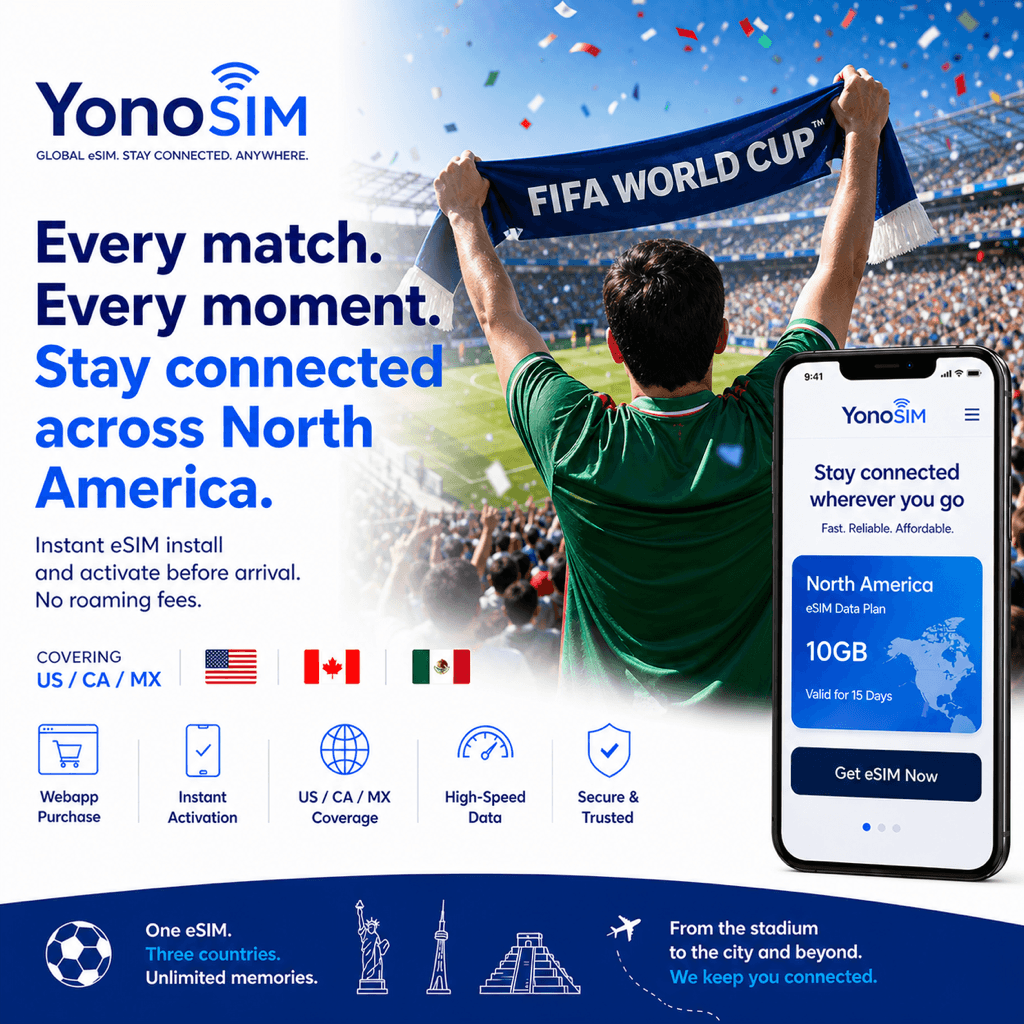
Mobile payments lean on a live connection: Apple Pay and Google Pay, your bank's app for fraud alerts, and currency converters all need data. A North America eSIM keeps the US, Canada and Mexico on one planfrom US$5, so you can tap to pay and check exchange rates in every host city without roaming fees. Install it on Wi-Fi before you fly and switch it on when you land — the same approach in our arrival-day checklist.
FAQ
QWhat currencies do I need for the 2026 World Cup?
AThree: US dollars in the United States, Canadian dollars in Canada and Mexican pesos in Mexico. Each country uses its own currency, so you can't pay with US dollars at most shops in Canada or Mexico.
QAre credit cards accepted across all three host countries?
AYes — Visa and Mastercard are widely accepted at hotels, restaurants and shops in the US, Canada and Mexico. Carry some local cash for markets, taxis and small vendors, which often require it, especially in Mexico.
QHow much should I tip at the World Cup 2026?
ATip 15–20% of the pre-tax bill at sit-down restaurants in all three countries. 15–20% is standard in the US and Canada and in Mexican tourist areas, while 10–15% is common inland. Check for an automatic service charge first.
QWhat's the cheapest way to get local cash?
ABank ATMs on the Visa/Mastercard networks give close to the interbank exchange rate — better than airport booths. Use machines inside banks or businesses, notify your bank before you travel, and decline the ATM's own currency-conversion offer.
Bottom line
Hold a little USD, CAD and MXN, lean on Visa or Mastercard, pull cash from bank ATMs and tip 15–20%. Keep a North America eSIM running so mobile payments and currency apps work everywhere, and grab your World Cup 2026 eSIM before you fly.