
Indonesia Travel Guide 2026: The 2024 Visa Cut (169 → 13), QRIS, Nyepi, Ojek & Phrases
The big one first: Indonesia's visa-free list was cut from 169 countries to 13 in August 2024. Americans, Canadians, Brits, Europeans, Australians, Kiwis, Japanese, and Koreans all need an e-VOA now — apply online before you fly. Plus how QRIS lets you pay a warung from your home wallet, how Bali shuts down for Nyepi, and the Bahasa phrases that quietly upgrade the trip.

Published July 27, 2026·21 min read
30-day auto-refund on no usageSummary
The single biggest thing to know before you book Indonesia in 2026: the visa-free short-visit list was cut from 169 countries to 13 in August 2024. If your passport is American, Canadian, British, EU, Australian, New Zealand, Japanese, Korean, Chinese, Indian — you now need an e-VOA (electronic Visa on Arrival, IDR 500,000 / ~US$32) applied for online at evisa.imigrasi.go.id before you fly. This guide leads with that, then covers QRIS (one warung sticker, six countries' wallets), how Gojek and Grab pick you up in Bali, the 24-hour shutdown of Nyepi (Mon March 8, 2027), and the Bahasa Indonesia phrases that quietly upgrade the trip. Cross-checked against Direktorat Jenderal Imigrasi, evisa.imigrasi.go.id, Love Bali, and Bank Indonesia (QRIS Antarnegara).
Do you need a visa? (the big 2024 cut, dated)
Stop — the biggest gotcha of the whole guide
If your passport is American, Canadian, British, EU, Australian, New Zealand, Japanese, Korean, Chinese, or Indian — you can no longer just show up at Denpasar or Jakarta with a passport and get a free 30-day stamp. Indonesia cut its visa-free short-visit list from 169 countries to 13 in August 2024. You now need to apply for an e-VOA (IDR 500,000 / ~US$32) online at evisa.imigrasi.go.id before you fly. It's a 5-minute form and approval is emailed within a day — but skip it and your airline may deny boarding at check-in.
This is the single biggest change to Indonesia travel in a decade, and it's the one that most travel articles still haven't updated for. Presidential Regulation Perpres 95/2024, signed August 29, 2024, dropped the number of visa-free-eligible countries from 169 down to 13. The 13 that remain are the ASEAN member states plus Timor-Leste and Hong Kong / Macao SAR passport holders. Everyone else — the entire Western and East Asian traveller base — goes through the e-VOA.
| Nationality | Visa-free? | What you need | Max stay |
|---|---|---|---|
| 🇸🇬 Singapore | Yes | Passport (ASEAN) | 30 days |
| 🇲🇾 Malaysia / 🇹🇭 Thailand / 🇵🇭 Philippines / 🇻🇳 Vietnam | Yes | Passport (ASEAN) | 30 days |
| 🇭🇰 Hong Kong SAR / 🇲🇴 Macao SAR | Yes | SAR passport | 30 days |
| 🇺🇸 United States / 🇨🇦 Canada | No — e-VOA | e-VOA IDR 500,000 (~US$32) online at evisa.imigrasi.go.id | 30 days, extendable +30 |
| 🇬🇧 UK / 🇩🇪 DE / 🇫🇷 FR / rest of EU | No — e-VOA | e-VOA online, apply 48 hrs before flight | 30 days, extendable +30 |
| 🇦🇺 Australia / 🇳🇿 New Zealand | No — e-VOA | e-VOA online | 30 days, extendable +30 |
| 🇯🇵 Japan / 🇰🇷 South Korea | No — e-VOA | e-VOA online | 30 days, extendable +30 |
| 🇨🇳 China (PRC) / 🇹🇼 Taiwan | No — e-VOA | e-VOA online | 30 days, extendable +30 |
| 🇮🇳 India | No — e-VOA | e-VOA online | 30 days, extendable +30 |
| Everyone else | No | Apply for a visa at the nearest Indonesian embassy before you fly | Varies |
Source: Direktorat Jenderal Imigrasi (imigrasi.go.id), Perpres 95/2024. Verify your specific passport at evisa.imigrasi.go.id before you book. e-VOA is a 5-minute online form; approval is emailed within a day. Print it or save the PDF for immigration.
The Bali Tourist Levy: IDR 150,000 before you land
Separate from any visa — every foreign visitor to Bali owes an IDR 150,000 (~US$10) tourist levy, active since February 14, 2024. Pay it online at lovebali.baliprov.go.id or the “Love Bali” app before you fly (card, QRIS, or bank transfer). Show the QR confirmation at the airport gate if asked. It is not required on other Indonesian islands.
Money: IDR, QRIS, wallets, and where cash is still king
Indonesia runs on the rupiah (IDR, Rp). The country has leapfrogged straight to QR-code payments — Bank Indonesia's QRIS system means a single QR sticker on the warung wall accepts every Indonesian wallet plus, thanks to cross-border interoperability, wallets from six partner countries. Still, cash is essential for the small stuff.
| Payment method | Where it works | Tourist tips |
|---|---|---|
| QRIS via cross-border wallet | Warungs, cafes, markets, taxis, most tourist spots | If you're coming from Thailand, Malaysia, Singapore, Japan, Korea, or China: open your home wallet, scan the QRIS sticker, done. No FX kiosk. |
| Credit / debit card (Visa, MC) | Hotels, chain restaurants, big retail, tourist attractions, Grab | Bring one with no foreign-transaction fee. Watch for the “DCC” trick — always pick to be charged in IDR, not your home currency. |
| Local wallet (GoPay, OVO, DANA) | Basically everywhere | Top-up needs an Indonesian bank account — not practical for a short trip. Skip unless you have local help. |
| Cash (rupiah) | Small warungs, temple donations, pasar markets, bemo, parking, tips | Withdraw from ATMs inside BCA / Mandiri / BNI bank branches (skimming risk on street ATMs). Yellow machines cap at Rp 1.25–3M; blue at Rp 10M. |
| Foreign Apple Pay / Google Pay | Chain retailers, malls | Works via the underlying card — treat it as tap-to-pay Visa/MC, not a local wallet. |
The signature quirk: QRIS — one sticker, every wallet
Indonesia's single most useful payment innovation is QRIS (Quick Response Code Indonesian Standard), launched by Bank Indonesia in 2019 as a national standard so that one QR sticker replaces the four or five different wallet QRs a warung would otherwise need. Today, a QRIS sticker on the wall accepts GoPay, OVO, DANA, ShopeePay, and every other Indonesian wallet — and, thanks to QRIS Antarnegara (cross-border QRIS), the wallets of six partner countries too.
The genuinely useful part for travellers is that last bit. If you fly in from Thailand, Malaysia, Singapore, Japan, South Korea, or mainland China, you can pay a Balinese warung directly from your home wallet. Open your home QR app, scan the QRIS sticker, type the rupiah amount, confirm — your app converts to your home currency at Bank Indonesia's interbank rate. No FX kiosk, no foreign-transaction fee, no cash.
| If you're from | Open this app | Status |
|---|---|---|
| 🇹🇭 Thailand | Any PromptPay-linked bank app (SCB, KBank, Bangkok Bank) | Live since 2022 |
| 🇲🇾 Malaysia | DuitNow / Maybank / TnG eWallet | Live since 2023 |
| 🇸🇬 Singapore | NETS / DBS PayLah! / OCBC PayAnyone | Live since 2023 |
| 🇯🇵 Japan | JPQR-compatible wallets (rolling out) | Live, wallet coverage growing |
| 🇰🇷 South Korea | Zero Pay-compatible bank apps | Live April 2026 |
| 🇨🇳 China | UnionPay / Alipay app | Live April 2026 |
Source: Bank Indonesia — QRIS Antarnegara. Cross-border QRIS charges no additional foreign-transaction fee at the payment layer — watch your home wallet's FX spread only.
If your home country isn't on that list, you're back on Grab (foreign Visa/MC works in the app) plus cash. Skip the airport currency kiosks — walk to any BCA or Mandiri ATM in the arrivals hall and withdraw at bank rate.
Heads up — Bali shuts down for Nyepi on Mon March 8, 2027
If your trip crosses Monday March 8, 2027, know that Bali stops for 24 hours. Ngurah Rai (DPS) airport closes — no flights land or leave. The Ministry of Communications orders mobile data switched off island-wide. Streets are silent, patrolled by village pecalang wardens. Hotels lock guests inside their compounds; hotel Wi-Fi typically stays on. Book around it, or book a hotel with good grounds and treat it as an enforced rest day. The ogoh-ogoh parade the evening before (Sun 7 Mar 2027) is one of the most spectacular street events in Southeast Asia — worth planning for. (The date moves each year on the Balinese Saka calendar and always falls in March.)
Getting around: Gojek, Grab, and the ojek


Indonesia has no unified metro system like Tokyo or Seoul, and Bali has no metro at all. Two apps cover almost everything: Gojek and Grab. Both are in English, both take foreign Visa/MC in the app, and both offer car rides, motorbike rides, and food delivery.
- Gojek — the home-market leader (born in Jakarta, part of GoTo). Strongest coverage across Java, Bali, and the second-tier cities. The green helmets are unmistakable. gojek.com
- Grab — regional Southeast Asian giant, equally strong in Bali, sometimes cheaper for cars. Same features, orange branding. grab.com/id
- Bluebird (metered taxi) — the honest metered-taxi brand. Bookable in the “My Bluebird” app or as GoCar/GoBluebird inside Gojek. If you ever need to hail a random cab off the street in Jakarta, only get in a Bluebird.
The ojek: motorcycle taxis you order in an app


The ojek (motorcycle taxi) is the single best way to move around Jakarta and Bali's clogged tourist zones for short hops. Booked in the app as GoRide (Gojek) or GrabBike (Grab). Fares are a fraction of a car — a 5 km GoRide is often IDR 15,000–25,000 (~US$1–1.60). Here's how the pickup actually goes:
- Book in the app. Your driver's bike plate and photo appear.
- Driver rolls up in the green Gojek jacket + green helmet (or orange for Grab), with a second helmet on their arm for you. Take it, put it on.
- Sit sideways or astride behind the driver, feet on the pegs. Hold the bar behind the seat, not the driver.
- Pay in the app (foreign card OK) or with cash on arrival — whichever you selected.
- Tip IDR 5,000–10,000 if the ride was good or the traffic brutal.
For rides over 8–10 km, especially in the rain or with luggage, switch to GoCar or GrabCar instead. The ojek is a two-wheel motorbike — no room for a suitcase.
Jakarta transit: MRT, LRT, and JakLingko


Jakarta has a proper rapid-transit network now — the tourist chaos of only knowing Grab rides is over. Four systems, all interoperable via one card:
- MRT Jakarta — the north-south line from Lebak Bulus (south) to Bundaran HI (central), with the northward extension to Kota under construction. Clean, cool, on-time.
- LRT Jabodebek — light rail from Dukuh Atas to Bekasi and Cibubur, opened 2023. Elevated, great skyline views.
- LRT Jakarta — smaller loop around Kelapa Gading.
- TransJakarta BRT — the world's longest bus-rapid-transit network, dedicated lanes, blows past traffic in central Jakarta.
- KRL Commuter — heavy commuter rail into the surrounding Bogor / Bekasi / Tangerang region.
The one card that works on all of them is JakLingko. You can also use any Indonesian bank IC card (TapCash from BNI, Flazz from BCA, e-Money from Mandiri, Brizzi from BRI). Buy a card at any station, top up at the machines with cash or a foreign card. Fares are distance-based, typically IDR 3,000–14,000 per ride.
Bali: no metro, so it's Gojek + private driver + scooter
Bali has no train, no subway, no BRT. Your options are Gojek/Grab for short hops, a private driver for full days (~IDR 600,000–800,000 or US$40–55 per day including fuel — the standard rate a hotel or driver will quote), or renting a scooter yourself. For airport transfer at Denpasar (DPS), since 2024 all Gojek/Grab pickups happen at a designated lot a short walk from arrivals; official taxi counters and Damri airport buses also run.
Renting a car or scooter: IDP, left-side driving, and the 2024 Bali crackdown
The rules for driving in Indonesia catch a lot of Bali visitors out — especially on scooters.
Indonesia issues 1968 Vienna Convention IDPs but has never ratified the 1968 convention. In practice, Indonesian traffic police accept both 1949 Geneva and 1968 Vienna IDPs from foreign tourists. Bring the paper booklet plus your original home licence and your passport. For a scooter, both the home licence and the IDP must be endorsed for motorcycles — a car-only licence isn't enough.
| Rental type | Required paperwork | Rough daily cost |
|---|---|---|
| Scooter (Bali, 125–150cc) | IDP with motorcycle endorsement + home motorcycle licence + passport + STNK (vehicle rego, from rental shop) | IDR 60,000–100,000 (~US$4–7) |
| Car rental (self-drive) | IDP (car) + home car licence + passport + credit card | IDR 350,000–600,000 (~US$23–40) |
| Car + driver (Bali full-day) | Passport, nothing else | IDR 600,000–800,000 (~US$40–55), fuel included |
Since 2024, Bali police have run high-visibility scooter crackdowns across Canggu, Seminyak, Kuta, and Uluwatu — the exact zones where most tourists ride. On-the-spot fines start at IDR 250,000 and rise fast for helmet violations or riding without the right licence. Both rider and passenger must wear a helmet; a shop-provided helmet is fine, but wear it fastened. Drive on the left (ex-Dutch colony, but LHT), keep the STNK in the seat compartment, and don't rent from any shop that isn't willing to hand you the paperwork.
Fuel at Pertamina stations: Pertalite (regular RON 90, subsidised), Pertamax (RON 92, standard for tourists' rental scooters), and Pertamax Turbo (RON 98, premium). Most rental scooters run happily on Pertamax. Small warungs also sell fuel by the litre out of glass bottles — fine in a pinch, more expensive.
Bahasa Indonesia phrases that quietly upgrade your trip
Bahasa Indonesia is one of the world's most learner-friendly languages — no tones, no verb conjugation, no gendered nouns, written in the Latin alphabet you already know. Pronunciation is close to phonetic. A handful of phrases — delivered with a smile — noticeably change how you get treated at the warung, the market, and in the back of a Gojek.
“Thank you” — the single most useful phrase in Indonesia — say it every time, everywhere
“You're welcome” — the reply when someone thanks you — pronounced 'sah-mah sah-mah'
“Excuse me” — squeezing past someone in a market, catching a waiter's eye, passing in front of someone seated
“Sorry” — bumping into someone, or opening a request politely — pairs well before a question
“How much is it?” — at markets, warungs, and any stall without a price tag — the opener for haggling
“Can it be cheaper?” — haggling — polite counter to the first quote. Only for markets and souvenir shops, never for restaurants or fixed-price malls
“Not spicy, please” — ordering — Indonesian chilli is legitimately hot. Add 'ya' at the end to soften the request
“Without ice” — ordering drinks — if you're worried about ice made from tap water. Most tourist restaurants use safe ice; small warungs, use judgement
“Very delicious!” — after a meal — the compliment the cook wants to hear. Instant good-will boost
“Where's the toilet?” — answered with a point 90% of the time — a small nod and 'terima kasih' seals it
“Please / help” — prepend to almost any request — 'tolong berhenti di sini' = 'please stop here' to a driver
“Brother (Betawi / Javanese)” — informal address for a male ojek driver, waiter, or shopkeeper. Bang in Jakarta / Sumatra; Mas in Java / Bali. Female equivalent: Mbak
Cultural norms: eight things first-timers get wrong
- Right hand only. For eating (especially with your hands, which is normal at padang restaurants), handing over money, receiving change, giving or accepting anything. The left hand is reserved for personal hygiene — using it socially is offensive across the country. Even pointing: use the thumb, not the index finger.
- Shoes off. Every mosque, every Balinese family compound, most warungs with floor seating, some homestays. Watch what the locals do at the door.
- Sarong at Hindu temples. Every Balinese temple — Uluwatu, Tanah Lot, Besakih — requires a sarong tied around your waist over your regular clothes, and often a sash. They're provided at the entrance, free with entry.
- Modest dress at religious sites. Shoulders and knees covered — both sexes, both Hindu temples and mosques. Women visiting a mosque need to cover their hair; a headscarf is usually lent at the door.
- Don't touch anyone's head. Including small children's. The head is spiritually the highest, most sacred part of the body across Indonesian cultures.
- Tipping is not required, but appreciated. Hotels and mid-range restaurants already add a 10% service charge on the bill (marked “service” or “plus plus”). Round up for Gojek and Grab drivers, IDR 10,000–20,000 for porters, nothing for taxi drivers unless the ride was excellent.
- Prayer times in Muslim areas. Outside of Bali, Indonesia is the world's largest Muslim country. In Jakarta, Yogyakarta, Sumatra, some restaurants and shops pause briefly during the five daily calls to prayer, especially at Friday noon. Dress a little more modestly near mosques on Fridays.
- Nyepi (Bali only, once a year). If your trip crosses Monday March 8, 2027 (or any Nyepi in a later year — it moves annually, always in March), stay in your accommodation. No beach, no ride-hailing, no outdoor lights, no phone data. Even the airport closes. Treat it as a day off; the calm is genuinely beautiful.
The daily-use Indonesia experience: warungs, Indomaret, and Alfamart
Indonesia's daily-life infrastructure is friendlier and cheaper than most travellers expect. The two pieces to know:
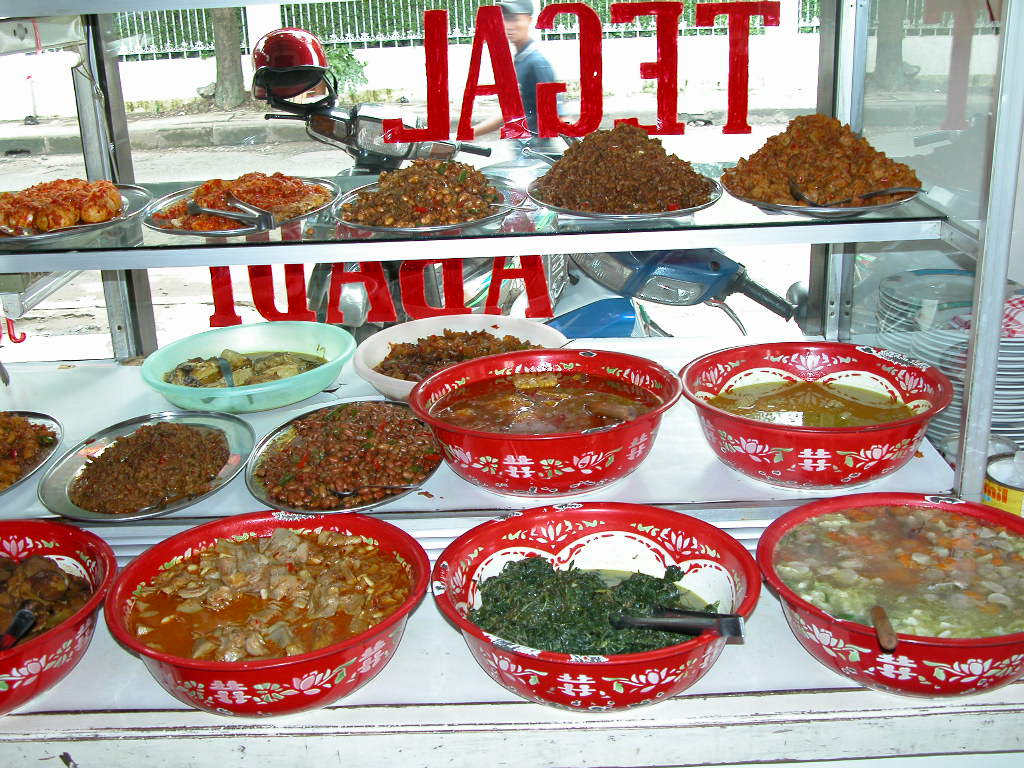

Warungs. The Indonesian equivalent of a mom-and-pop diner — small, cheap, and the best food in the country. A Warteg (Warung Tegal) works cafeteria-style: point at the dishes you want behind the glass, they scoop onto rice, you pay at the end. A nasi campur (mixed rice — rice + a few of whatever they have that day) is the default order, often IDR 20,000–35,000. Cash or QRIS at most; card rare.
Indomaret and Alfamart. The 7-Eleven-equivalents of Indonesia. On every corner in every town in the archipelago, open 06:00–23:00 or 24 hours. Bottled water, packaged snacks, SIM cards (physical, needs passport), phone top-ups, cash withdrawals via QRIS, and cold drinks. If you need something basic, walk to the nearest Indomaret and it will be there. Air-con is a bonus on a hot day.
Ojol as errand runner. Both Gojek and Grab do GoSend / GrabExpress (courier) and GoFood / GrabFood (food delivery). If your favourite warung is a 20-minute walk in Bali heat, order in and pay in the app. A GoFood delivery fee in Bali is usually IDR 8,000–15,000.
The rice terraces, the temples, and Borobudur


Two rice-terrace notes for planning: Tegallalang, north of Ubud, is the most Instagrammed — it's beautiful but very touristy and there's a small “donation” expected at each viewpoint. Jatiluwih, further west, is UNESCO-listed and much quieter — a proper walking loop through actual working farmland.


Off Bali, the two set-pieces are Borobudur (9th-century Buddhist temple — the biggest in the world) and Prambanan (9th-century Hindu temple complex), both near Yogyakarta on Java. Since 2023, Borobudur upper-terrace access is regulated: you book a timed sandaled-only slot in advance via the official ticket portal; the surrounding park is walk-in.


Staying connected: skip the roaming bill
Your home carrier's Indonesia roaming pass runs US$10–15 per day — for a two-week trip that's $150+ before you've looked at a single map. A travel eSIM backed by Telkomsel gets you the same widest-coverage network for about US$15 total for a 20 GB tourist plan. Physical prepaid SIMs in Indonesia still require passport SIM-registration at the airport kiosk; eSIMs skip that entirely.
The setup: install the eSIM on Wi-Fi before you fly, keep your home SIM in the phone with roaming off so your number still gets SMS 2FA codes, and set the eSIM as your data line. Land in Denpasar or Soekarno–Hatta, walk out of the airport, Grab and Google Maps are already working. Related reads:
- Best eSIM for Bali & Indonesia 2026 — buying guide
- What Reddit actually recommends for Bali eSIMs
- YonoSIM Indonesia coverage & plans
- Keep your home number abroad — eSIM + Wi-Fi Calling
FAQ
QDo I still get in visa-free to Indonesia in 2026?
AAlmost certainly not — unless you hold an ASEAN passport, Timor-Leste, or a Hong Kong / Macao SAR passport. Presidential Regulation 95/2024 (signed August 29, 2024) cut Indonesia's visa-free short-visit list from 169 countries down to 13. Every other visitor — US, Canada, UK, EU, Australia, New Zealand, Japan, Korea — now needs an e-VOA (electronic Visa on Arrival) at IDR 500,000 (~US$32) applied for online at evisa.imigrasi.go.id before you fly. It's a 5-minute form and pre-approval is emailed within a day.
QWhat is QRIS and can I use it as a tourist?
AQRIS (Quick Response Code Indonesian Standard) is Bank Indonesia's national QR: one code on the warung wall accepts every Indonesian wallet — GoPay, OVO, DANA, ShopeePay — and, thanks to cross-border QRIS, wallets from Thailand (PromptPay), Malaysia (DuitNow), Singapore (NETS), Japan, South Korea, and mainland China (Alipay/UnionPay). If you're coming from any of those six countries you can pay a Balinese warung directly from your home wallet. If not, most tourists still lean on Grab (foreign Visa/MC works) and cash — local wallets like GoPay require an Indonesian bank account to top up.
QDo I need cash in Indonesia?
AYes, more than you'd think. Cities and tourist zones are card- and QRIS-friendly, but small warungs, temple donation boxes, traditional markets (pasar), bemo minibuses, parking attendants, and satay carts are cash only. A working baseline is IDR 500,000–1,000,000 (~US$32–65) of rupiah in your wallet. Use ATMs inside bank branches (BCA, Mandiri, BNI) to avoid skimming; per-withdrawal limits are IDR 1.25–3M on yellow (Rp 50k) machines and up to IDR 10M on blue (Rp 100k) machines.
QWhat happens on Nyepi in Bali and when is the next one?
ANyepi — Bali's Hindu New Year Day of Silence — is Monday, March 8, 2027, 06:00 to Tuesday March 9, 06:00 (24 hours). The date moves each year on the Balinese Saka calendar and always falls in March. Ngurah Rai (DPS) airport closes: no flights in or out. Streets are silent, patrolled by village pecalang wardens. The government orders mobile data switched off island-wide for the day (hotel Wi-Fi typically stays on). Hotels lock guests inside their grounds. Book around it, or book a hotel with good grounds and treat it as a rest day. The ogoh-ogoh parade the night before (Sun March 7, 2027) is spectacular.
QCan I drive in Indonesia on my home licence?
AYou need an International Driving Permit — Indonesia in practice accepts both 1949 Geneva and 1968 Vienna IDPs, plus your original home licence and passport. For a scooter (Bali) you also need the motorcycle endorsement on both the home licence and the IDP. Since 2024, Bali police have run high-visibility crackdowns across Canggu, Seminyak, Kuta, and Uluwatu — on-the-spot fines from IDR 250k. Wear the helmet (both rider and passenger, both mandatory), carry the STNK vehicle registration, and don't rent unlicensed.
QWhat's the cheapest way to get mobile data as a tourist?
AA Telkomsel-backed travel eSIM. Telkomsel has Indonesia's widest coverage and is the only network that reliably reaches Nusa Penida, Lombok, and the Gili Islands — a 20 GB tourist plan runs about US$15, a fraction of the US$10–15 per day your home carrier charges to roam. Install it on Wi-Fi before you fly, keep your home SIM in the phone with roaming off so it can still receive SMS 2FA codes. eSIMs also skip the passport SIM-registration desk at the airport that physical prepaid SIMs still require.
Photo credits
In-post photos are used under their respective Creative Commons licences. Full source pages are linked in each caption.
- Gojek riders in Salatiga — Hanif Al Husaini, CC BY 4.0.
- Ojek driver in Kota Mentok — Cun Cun, CC BY-SA 4.0.
- Jakarta MRT Bundaran HI station — Ramses Sinaga, CC BY-SA 4.0.
- Warteg food spread — Veriyanta Kusuma, CC BY-SA 3.0.
- Jatiluwih rice terraces — Imacim, CC BY-SA 4.0.
- Borobudur north-west view — Gunawan Kartapranata, CC BY-SA 3.0.
- Ogoh-ogoh at the Ngrupuk parade in Ubud — MagdaLena7, CC BY-SA 4.0.
Bottom line
Indonesia rewards a small amount of preparation with an outsized amount of ease. Before you fly: confirm whether you need the e-VOA (almost certainly yes, unless you hold an ASEAN or SAR passport), pay the Bali tourist levy if Bali is on your itinerary, install Gojek and Grab, and set up a Telkomsel eSIM so your phone is online before you leave the arrivals hall. Bring an IDP if you plan to ride. Check whether your trip crosses March 8, 2027 — that's Nyepi, and it changes what a Bali day looks like completely. On the ground: scan the QRIS sticker with whatever wallet you have, carry rupiah cash for warungs and temples, right hand for everything, sarong at the temple gate, and say terima kasih often. The rest works out.
Originally published on www.yonosim.com/en/blog/indonesia-travel-guide-2026 · YonoSIM — You Only Need One SIM