

If You Didn't Use It, You Shouldn't Be Charged for It: YonoSIM's First 30-Day Auto-Refund Just Went Out (2026)
You shouldn't get charged for a travel eSIM you didn't get to use — that's the standard YonoSIM operates by, and the standard the whole industry should operate by. Today the daily 30-day sweep fired for the first time: US$12.08 back on a Visa card, one warm confirmation email in Japanese, zero support tickets. Receipts, not policy language.

Published August 12, 2026·5 min read
30-day auto-refund on no usageSummary
On July 16, 2026 we published a post promising that YonoSIM would auto-refund any Stripe-paid travel eSIM that showed zero data used after 30 days — no support ticket, no drop-down, no explanation. Today, exactly one full 30-day cycle after the sweep went live in production, the first automatic refund fired for real: US$12.08 back to a Visa card, one warm confirmation email in Japanese, and zero support tickets. This post is the receipt.
What just happened
A traveler bought a United States 10GB / 30-day plan on the YonoSIM Japanese site roughly a month ago. The eSIM was provisioned. The QR code was delivered. And then — for whatever reason (trip changed, device incompatibility, forgot to install, changed their mind) — no data was ever consumed against the profile. Under every competitor's policy, the plan would have simply expired and the money would have stayed with the seller unless the customer proactively opened a support ticket and argued their case.
Instead, at the next daily sweep after day 30, our cron picked up the order, checked our network provider's authoritative usage signal, confirmed zero consumption, released the profile, and refunded US$12.08 back to the original Visa card via Stripe. The customer received a warm confirmation email in Japanese that told them exactly what plan was refunded, the exact amount, the destination card (masked to the last four), and the 5–10 business day bank timeline. It explicitly said no reply was needed.
The customer never wrote to us. The first they heard about it was that email.
Why we're publishing this
The flagship post from July laid out the mechanism in detail — the daily cron, the 30-to-60-day age filter, the Canadian carve-out, the usage check against our network provider, the cancel-before-refund ordering, the warm 13-locale confirmation email. But until today, none of that had actually fired for a real customer. It was a well-documented promise.
Every major travel eSIM app publishes a refund policy. What made ours different, we argued, was not the policy language — it was the fact that we would do the work of noticing and firing the refund ourselves, instead of hiding the escape hatch behind a support form the customer would have to find, understand, and use in their second or third language. Publishing the first receipt closes that loop. The sweep runs. The money returns. The email lands.
The confirmation email, in the customer's language
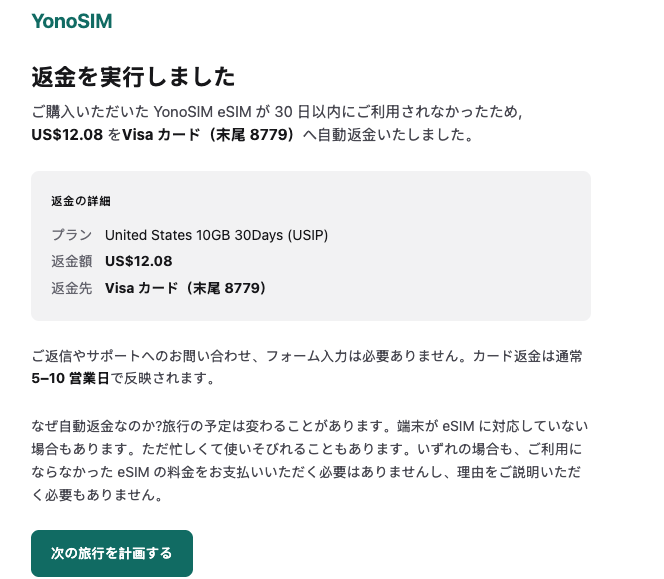
Because the buyer was on the Japanese site, the confirmation arrived in Japanese. The subject line reads “返金を実行しました” (“Refund issued”), followed by:
ご購入いただいた YonoSIM eSIM が 30 日以内にご利用されなかったため、US$12.08 を Visa カード(末尾 8779)へ自動返金いたしました。
(Translation: “Because your YonoSIM eSIM was not used within 30 days, we have automatically refunded US$12.08 to the Visa card ending in 8779.”)
Below that, a small box lists the plan (“United States 10GB 30Days (USIP)”), the refund amount, and the destination card. A second paragraph, translated:
“There is no need to reply or contact support, and no form to fill out. Card refunds typically take 5–10 business days to appear on your statement.”
And then the part we care about most — the tone: “なぜ自動返金 なのか?” (“Why an automatic refund?”) — followed by:
“Trip plans change. Some devices don't support eSIM. And sometimes life gets busy and you forget to use the eSIM. In any of those cases, you shouldn't have to pay for an eSIM you didn't use, and you shouldn't have to explain why.”
The English, German, Chinese, Korean, Polish and eight other locale variants say the same thing in the same non-apologetic voice. An unused eSIM is a normal life outcome, not a failure the customer needs to justify.
What the first sweep proved
A few small things, most of them boring — which is exactly the point.
- The daily cron runs and completes. The Vercel Cron fired on schedule, hit our authenticated route, and returned within the timeout window. There is no operational surprise waiting for us on day 30 of a real customer's journey.
- The network-provider usage check is the right authority. The profile was released cleanly at the provider level before the refund was issued to the card, which means the money returned to our Stripe balance first and then to the customer. Never refund before cancel — otherwise you refund an eSIM that's still consumable upstream.
- The idempotency guard held. The order was claimed exactly once in our
esim_lifecycle_notificationstable with theauto_refund_30dayreason, and the Stripe refund used the deterministic idempotency key. If the cron re-runs against the same order, nothing happens twice. - Locale routing worked end to end. The customer bought on
/ja, so the confirmation email rendered from the Japanese template — the same one that has to survive being rendered in 13 languages without an English fallback slipping in. - Silence is a good signal. The customer received the email and did not reply, did not open a ticket, did not raise a dispute. On a mechanism designed to notice on the customer's behalf, silence is the intended outcome.
Where this fits in the head-to-head
Every major competitor will, eventually, refund an unused eSIM. We wrote up each one against our own policy so you can compare on the specifics — window length, what you have to do, whether you get real money or store credit, whether there's an admin fee:
- YonoSIM vs Saily refund policy (2026) — same 30-day window; Saily needs a support ticket and takes up to five working days.
- YonoSIM vs Airalo refund policy (2026) — 14-day window; most refunds default to Airmoney store credit.
- YonoSIM vs Holafly refund policy (2026) — six-month window; email support required; $3.50 USD admin fee may apply.
- YonoSIM vs Nomad refund policy (2026) — 30-day window; requires chat outreach; Nomad Points offered by default.
For the wider picture, see our full travel-eSIM refund-policy roundup (windows, formats, fees for every major provider) and the underlying why-eSIMs-are-structurally-hard-to-refund explainer that explains why the industry defaults to a support-ticket wall in the first place.
The competitor policies aren't hostile — they just require the customer to do the work of noticing. Our bet is that the sweep is a better trade than the ticket wall, and today's $12.08 receipt is the first small confirmation that the trade is real.
FAQ
QWho received the first automatic refund and what did they buy?
AA traveler who bought a United States 10GB / 30-day plan and never used the eSIM against our network provider. We're not naming the customer for obvious reasons, but the refund was US$12.08 back to a Visa card, issued to the original payment method via Stripe, with a warm confirmation email in the buyer's site language (Japanese in this case). No support ticket was ever opened by the customer — the first they heard about it was the email.
QDoes this mean the auto-refund is fully live for every non-Canadian YonoSIM plan?
AYes. The cron runs daily and covers every Stripe-paid, provisioned plan whose coverage does not include Canada. If your plan sits at zero data used on our network provider by day 30 (with a 60-day back-catch so a skipped sweep never shrinks the window), it is refunded to your original card automatically, and you receive a warm confirmation email in the same language you bought in. Canadian plans remain final sale and this is disclosed with a pre-purchase pop-up at checkout on any plan whose coverage includes Canada.
QWhat language did the first confirmation email arrive in?
AJapanese, because the customer bought on the /ja locale of the YonoSIM site. The auto-refund confirmation template is written to be warm and non-apologetic in 13 locales — an unused eSIM is a normal life outcome, not something the customer should feel obligated to explain. The email states the plan name, the exact refund amount, the destination card, and the 5–10 business day bank timeline, and it explicitly says no reply is needed.
QWhy celebrate a single refund publicly?
ABecause the flagship promise post from July 2026 was, until today, still a promise. Every travel eSIM store publishes a refund policy; the reason we called ours out as an industry first is not the policy language but the mechanism — a daily cron that sweeps unused plans and fires the refund without the customer having to notice. Publishing the receipt closes the loop: the sweep runs, the money returns, the email lands. If you're a first-time YonoSIM buyer, this is the proof point the flagship post couldn't yet offer.
QWhat was the exact refund amount and why?
AUS$12.08. The plan was the United States 10GB / 30-day standard plan (SKU USIP), and $12.08 is the full amount the customer paid net of Stripe's fee-passthrough policy for that account. First-time refunds under YonoSIM's repeat-refund policy are absorbed in full — we do not pass processing fees back on a first refund on a given email. The card refund lands on the customer's statement in the normal 5–10 business days.
Bottom line
If you didn't get to use it, you shouldn't be charged for it. That's the standard YonoSIM operates by, and — honestly — it should be the standard the whole travel eSIM industry operates by. Every competitor has a policy that eventually lands there if the customer pushes hard enough, but “eventually, if you push hard enough” is not a standard. It's a filter.
We built the 30-day automatic no-usage refund because that filter quietly catches the customers who most deserved the refund. Today the mechanism fired for the first time on a real order: US$12.08 back to a Visa card, no ticket, one warm email in Japanese. That's the whole story. If your device turns out to be incompatible, if your trip changes, if you forget the eSIM exists, we'll notice, and we'll give you your money back automatically. You don't have to write to us. You don't have to explain. That's the promise, and now it's the receipt.
Originally published on www.yonosim.com/en/blog/first-30-day-auto-refund-issued-2026 · YonoSIM — You Only Need One SIM