

Hong Kong Travel Guide 2026: Visas, Octopus, Red Minibus 有落, Star Ferry, Taxis & Phrases
The one Hong Kong travel guide that actually shows you how to shout 有落 (yau lok) to get off a red minibus, whether you need a visa (dated table), how to put Octopus on your iPhone, which taxi color goes where, and the Cantonese phrases that make the trip smoother.

Published July 27, 2026·20 min read
30-day auto-refund on no usageSummary
A deep-dive Hong Kong travel guide for 2026 — the one that explains how to shout 有落 (yáuh lohk) to make a red minibus stop, whether you need a visa (dated country table), how to add Octopus to Apple Wallet and never touch plastic, which taxi colour goes where, and the Cantonese phrases that quietly upgrade the trip. Cross-checked against Hong Kong Immigration Department, Octopus, and MTR.


Do you need a visa? (dated, by country)
Hong Kong runs its own immigration separate from mainland China — a legacy of the “one country, two systems” framework. That means visiting Hong Kong does NOT count as visiting mainland China, and the visa rules are different. Most Western passport holders enter visa-free at Chek Lap Kok for 90 days; British passport holders get 180 days. The list is maintained by the Hong Kong Immigration Department.
| Nationality | Visa needed? | Max stay | Notes |
|---|---|---|---|
| 🇬🇧 United Kingdom | No | 180 days | Longest visa-free stay of any nationality |
| 🇨🇦 Canada | No | 90 days | Visa-free tourism / business |
| 🇺🇸 United States | No | 90 days | Visa-free tourism / business |
| 🇦🇺 Australia | No | 90 days | Visa-free tourism / business |
| 🇳🇿 New Zealand | No | 90 days | Visa-free tourism / business |
| 🇩🇪 Germany | No | 90 days | Most Schengen countries the same |
| 🇫🇷 France | No | 90 days | Visa-free tourism / business |
| 🇯🇵 Japan | No | 90 days | Visa-free tourism / business |
| 🇰🇷 South Korea | No | 90 days | Visa-free tourism / business |
| 🇸🇬 Singapore | No | 90 days | Visa-free tourism / business |
| 🇹🇼 Taiwan | No | 30 days | Must pre-register online (i-Permit for Taiwan Residents) |
| 🇨🇳 Mainland China | Permit | Per permit | Uses the “Exit-Entry Permit for Travelling to and from Hong Kong and Macao” instead of a visa |
| 🇮🇳 India | Pre-arrival | 14 days | Free online “Pre-arrival Registration for Indian Nationals” via Immigration Department |
| 🇵🇭 Philippines | No | 14 days | Visa-free tourism |
Source: Hong Kong Immigration Department. Verify at immd.gov.hk before you book.
Money: Octopus, contactless, and where cash still shows up
Hong Kong runs on the Hong Kong dollar (HKD, HK$), pegged to the US dollar at roughly HK$7.80 = US$1. It is a genuinely cashless city — more so than either London or Tokyo. Effectively every restaurant, shop, MTR gate, bus, tram, ferry and 7-Eleven accepts Octopus. Every chain retailer and most restaurants also take contactless credit cards. QR-code apps Alipay HK and WeChat Pay HKdominate for locals, but tourists rarely need them. A useful cash baseline is HK$500-1,000 for red minibuses, older wet markets, and dai pai dong.


| Payment method | Where it works | Tourist tips |
|---|---|---|
| Octopus (八達通) | MTR, buses, trams, Star Ferry, green minibuses, 7-Eleven, Circle K, McDonald's, most cha chaan teng, vending machines | Add to Apple Wallet on any iPhone or Samsung Wallet on newer Galaxy — instant. Otherwise buy a Sold Tourist Octopus at any MTR Customer Service Centre (HK$39, no deposit). |
| Contactless credit card (Visa / MC / AmEx) | MTR (since 2024), most buses, all chain restaurants, hotels, retail | Tap-to-pay is universal. Bring one that has no foreign-transaction fee. |
| Alipay HK / WeChat Pay HK | Locals' default at small restaurants, night markets, some cabs | Foreign versions of Alipay / WeChat Pay work at most merchants via the “Tour Card” feature — but Octopus + a card covers everything you need. |
| Cash (HK$) | Red minibuses, wet markets, older dai pai dong, some NT taxis | Withdraw at HSBC, Hang Seng, Standard Chartered ATMs — airport ATMs take foreign cards. |
| Foreign Apple Pay / Google Pay | Chain retailers, big restaurants, most terminals with NFC | Works via the underlying card — not the same as an Octopus in Apple Wallet. |
MTR, ferries, trams: the transit stack
Hong Kong's MTR is the backbone — 11 heavy-rail lines connecting Hong Kong Island, Kowloon, the New Territories, and the airport, plus the Light Rail in the northwest NT. Base fare with Octopus is around HK$5-6 for short trips and maxes out around HK$60 for the Airport Express. Tap in, tap out, done. Trains run roughly 05:30 to midnight (later on weekends), typically every 2-4 minutes at peak.
The Airport Express deserves a mention: 24 minutes from Chek Lap Kok to Central for HK$115 with Octopus (about HK$100 with the discounted “Same-Day-Return” option), vs. a HK$350+ taxi. Buy your Octopus at the airport before you ride if you don't have iPhone Octopus already.

.jpg)
The Star Ferry connects Central and Wan Chai on Hong Kong Island with Tsim Sha Tsui on Kowloon — HK$5-6 for the upper deck (better view), HK$4-5 for the lower deck. Runs every ~8 minutes. Iconic and cheap. Octopus works.


The trams (電車, or “ding ding” for the bell) are the century-old double-deckers that run east-west across the north side of Hong Kong Island. Flat HK$3 fare, pay with Octopus when you get off at the front. Slow and glorious — take the upper deck front seat if you can, especially at night through Wan Chai.
The red minibus: the ritual nobody warns you about
This is the local transit mechanic that trips up every tourist trying to be adventurous in Hong Kong. Minibuses come in two colours, and they do not work the same way:
- Green minibuses (綠Van) — government-regulated, fixed routes, fixed stops, fixed fares, Octopus accepted, English destination boards. Ride these like a small bus. Tap Octopus when you board (some routes) or when you get off (others — the reader is at the front near the driver either way).
- Red minibuses (紅Van) — privately operated, flexible routes, no printed stops, and cash only. Popular for suburban runs and late-night when regular buses have stopped. You need to know your destination, and you need to know how to get off. That's the ritual.


The step-by-step, when you find yourself on a red minibus for the first time:
- Board at a licensed stop or hail one at the kerb. Red minibuses stop where it's legal, not on a schedule. If it's slowing down or picking up, wave.
- Sit down — there's only 16 seats, and standing is not allowed by law.If the bus is full, wait for the next one.
- Look at the fare placard next to the driver. It shows the fare for common destinations along the route. If you don't see yours, ask the driver “去銅鑼灣幾錢?” (heui tùhng lòh wàan géi chín? — how much to Causeway Bay?).
- When you're one block from your stop, call out “有落!” (yáuh lohk — “getting off”). Or in English: “next stop please.” The driver will pull over at the nearest safe kerb.
- Pay as you get off. Cash only — exact change is appreciated but not required for most routes; the driver gives change from a fare box or their own pocket. No receipt.
If your Cantonese is zero, you can ride green minibuses and skip red minibuses entirely — the MTR + green minibuses + Star Ferry + taxis cover everything a tourist needs. But if you ever need to get from Central to Aberdeen at 1am, or from Sai Kung back to Mong Kok, the red minibus is the ride, and yáuh lohk is the one word you need.
Taxis: colour by region


Hong Kong taxis are colour-coded by service area, and it matters — a red taxi cannot pick up in the northern New Territories, and a green one cannot enter Central. Meters run the same formula within each region; there is no tipping beyond rounding up:
| Colour | Service area | Flag fall (2026) | Notes |
|---|---|---|---|
| 🔴 Red (Urban) | Hong Kong Island, Kowloon, most NT | ~HK$29 for 2 km | The one you'll flag 90% of the time |
| 🟢 Green (NT) | New Territories only (Sai Kung, Yuen Long, Tuen Mun) | ~HK$25 for 2 km | Cannot enter urban zone |
| 🔵 Blue (Lantau) | Lantau Island only | ~HK$24 for 2 km | Airport / Ngong Ping / south Lantau |
Two apps to know:
- HKTaxi — the local dispatch app used by most licensed taxis. English UI, foreign credit card accepted, no surge pricing (taxis are metered by law). This is the install. hktaxi.app
- Uber — Uber operates in a legal grey zone in Hong Kong (private drivers don't hold a hire-car permit), but it works and prices are transparent. Many locals use it; enforcement against passengers has been non-existent.
Cash is still preferred in most red taxis but a growing number take Octopus and contactless card. Ask before you get in: “八達通得唔得?” (baat daaht tùng dàk m̀h dàk? — “Octopus okay?”).
Renting a car: rarely worth it, and here's why
Renting a car in Hong Kong is unusual for tourists, and for good reasons: the MTR + taxis + Star Ferry + minibuses cover everywhere you want to go for a fraction of the parking cost, HK drives on the left (with a right-hand-drive car, opposite of North America and continental Europe), and parking in Central runs HK$50-100 per hour. If you still want to drive:
- 1949 Geneva IDP + home licence + passport — Canada, US, UK, Australia, NZ, EU: get the IDP from your national auto club before flying.
- Never drive across the border into mainland China on a rental. Cross-border driving requires separate permits and dual licence plates — there are specialty rental companies that arrange this, but a regular HK Avis / Hertz will not let the car leave the SAR.
- Tolls use the AutoToll transponder or increasingly a licence-plate scan system. Almost every rental car comes pre-fitted — ask at the counter.
Realistically, the only travellers who rent are those exploring the New Territories or the outer islands on a self-drive weekend. Otherwise, take the MTR.
Cantonese phrases that will quietly upgrade your trip
Cantonese has nine tones. Nobody expects you to nail them. But a handful of phrases — delivered with a small nod — noticeably change how people treat you. English is widely spoken in Central, Tsim Sha Tsui and touristy Kowloon; less so in Wan Chai, Mong Kok, and the NT. Here are the ones with the highest return.
“Hello” — the universal polite greeting — say it walking into a shop, restaurant, or taxi
“Thank you / excuse me (multi-purpose)” — the single most useful word in Cantonese — flag a waiter, thank a taxi driver, apologise for bumping someone
“Thank you (for a gift or a favour)” — when someone gave you something — different word from m̀h gōi, which is for a service
“Sorry (real apology)” — stronger than m̀h gōi — use when you actually stepped on someone's foot
“Getting off (red minibus)” — the single phrase that gets you off a red minibus — call it a block early, driver pulls over
“This one” — point + say this — universal ordering hack at cha chaan teng, dim sum, market stalls
“How much is it?” — at wet markets and street stalls where prices aren't tagged
“Bill please” — cha chaan teng and small restaurants — waiter brings the bill to your table
“Where's the bathroom?” — answered with a point 90% of the time
“Do you have an English menu?” — most cha chaan teng and casual restaurants have one — hidden under the counter
“Delicious” — say it once mid-meal at any small restaurant and watch the auntie's face
“Is Octopus okay?” — checking at a small taxi or dai pai dong whether Octopus is accepted before you order
Cultural norms: the eight things that catch visitors out
- Don't tip. Restaurants add a 10% service charge automatically. Taxis expect at most rounding up. Hotel porters and concierges appreciate HK$20-50 for real help. Everywhere else, no tip is required.
- Never eat or drink on the MTR. It's illegal in the paid area — HK$2,000 fine, actively enforced. Finish your bubble tea before you tap in.
- Stand on the right on escalators. Walking side is the left. Blocking the left side in Central Station at 8:45am will earn you audible tsking.
- Queue rigorously. Hong Kongers queue in orderly single-file lines for buses, MTR platforms, taxi ranks and dim sum restaurants. Cutting is very visibly noticed.
- Use two hands for anything important. Business cards, restaurant bills, giving cash to an older person — use both hands or right hand supported at the wrist by the left. Small gesture, big signal of respect.
- Don't stick chopsticks vertically in a rice bowl. The visual mirrors funeral incense. Rest them on the chopstick rest or across the top of your bowl.
- Handshake and slight bow. Hong Kongers do a Western handshake for business and social introductions — often with a small nod. Hugs are for close friends only.
- Pass the teapot lid. At dim sum, tilting the teapot lid open on top signals the waiter to refill hot water. A tap of two fingers on the table when someone pours tea for you says thank you without breaking conversation.
7-Eleven, wet markets, cha chaan teng — the little Hong Kong experience
These are the daily-use systems that make Hong Kong feel unusually functional — and they save first-time visitors a lot of money.
7-Eleven & Circle K. Over 1,300 stores across the SAR, most open 24/7. You can eat well for HK$30-40 (siu mai + oolong tea + polo bun), reload Octopus, buy a SIM, use the ATM if it's a HSBC/Bank of China one, and pick up an umbrella when a black rainstorm signal goes up. Every one is a Google Maps pin and every one takes Octopus.
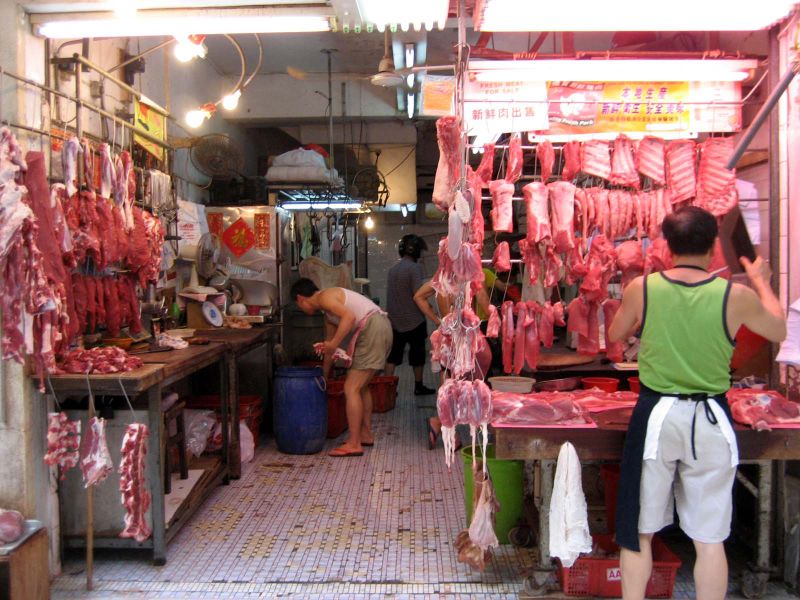

Wet markets (街市). Every neighbourhood has one, most on the ground floor of a multi-storey municipal services building. Fresh seafood, vegetables, tofu, butchered meat — the ingredient supply chain that made Hong Kong food culture. Cash only, and vendors don't speak much English. Even if you're not cooking, a walk-through of Central's Graham Street Market or Wan Chai's Bowrington Road Market is worth an hour.
Cha chaan teng (茶餐廳, “tea restaurant”). The classic Hong Kong daily diner: milk tea, macaroni soup with ham, French toast with syrup, and pineapple bun. HK$50-80 for a full set. Every neighbourhood has three. Order using “呢個” (nī go) and a point at the plastic menu — nobody minds.
Dai pai dong (大牌檔). The vanishing open-air street food stalls, mostly in Central's SoHo and around Sham Shui Po. Wok hei-heavy stir-fry, seafood, congee. Cash only, no English menu, no reservations, ridiculous value. Central's Sing Heung Yuen (勝香園) is the internet-famous one for tomato beef noodles.
Staying connected: skip the roaming bill
Your home carrier's Hong Kong roaming add-on runs C$12-15 or roughly US$10 per day — for a two-week trip that's $150+ just to open Google Maps. A Hong Kong travel eSIM gets you the same 3, CSL, SmarTone or CMHK network for a few dollars total.
The setup that works best: install the Hong Kong eSIM on Wi-Fi before you fly, keep your home SIM in the phone with roaming off so your number still receives SMS two-factor codes, and set the eSIM as your data line. Land, tap out at HKG immigration, Google Maps already knows where you are. Related reads:
- Best Hong Kong eSIM 2026 — buying guide
- Best China eSIM (if crossing to Shenzhen)
- Korea Travel Guide 2026 (companion post)
- Japan Travel Guide 2026 (companion post)
FAQ
QDo I need a visa to visit Hong Kong in 2026?
AHong Kong runs its own immigration separate from mainland China. Citizens of most Western countries can enter Hong Kong visa-free — Canada, the United States, Australia, New Zealand, Japan, Korea, Singapore and most EU/Schengen countries for 90 days; British passport holders for 180 days. Mainland Chinese passport holders need a special permit rather than a visa. There is no ETA/ESTA-style pre-arrival application for tourists — you fill an electronic arrival card at the border kiosk on landing.
QWhat is a Hong Kong red minibus and how do I get off?
ARed minibuses (紅Van) are privately operated 16-seater public light buses that run on flexible routes with no printed stops. You board where you see one waiting or hail one at a licensed stop; sit down, note the fare on the placard by the driver; and when you're about a block from where you want out, call 有落 (yau lok — 'getting off') in Cantonese, or just 'next stop please' in English. The driver pulls over at the nearest legal spot. Cash only — no Octopus. Green minibuses are the regulated cousin: fixed stops, fixed fares, Octopus accepted, and no shouting needed.
QShould I get an Octopus card as a tourist?
AYes — Octopus is the single card that covers the MTR, buses, trams, the Star Ferry, most minibuses (green only), 7-Eleven, Circle K, supermarkets, vending machines, and increasingly taxis. The easiest option in 2026 is to add Octopus directly to Apple Wallet on any iPhone or to Samsung Wallet on newer Galaxies — you can top up with your foreign credit card and never touch plastic. If your phone can't do that, buy a Sold Tourist Octopus at any MTR Customer Service Centre (HK$39 non-refundable, no deposit) and reload with cash at 7-Eleven, Circle K, or MTR add-value machines.
QDo I need cash in Hong Kong?
ASome. Hong Kong is heavily cashless — Octopus + contactless credit card + Alipay HK cover most everything — but red minibuses, older wet markets, some cha chaan teng, and dai pai dong stalls are still cash-only. A useful baseline is HK$500-1,000 in your wallet, then use Octopus or a card for everything else. Withdraw at any HSBC, Hang Seng or Standard Chartered ATM; airport ATMs work with foreign cards.
QShould I tip in Hong Kong?
ANot really. Restaurants add a 10% service charge automatically — nothing more is expected. Taxis do not expect a tip; most locals round up to the nearest dollar or leave the coins. Hotel porters and concierges appreciate HK$20-50 for real help. Tour guides in a private setting HK$100-200 per day is generous. Everywhere else, no tip is required and pressing cash on someone can cause confusion.
QWhat's the cheapest way to get mobile data as a tourist in Hong Kong?
AA Hong Kong travel eSIM installed on your unlocked phone runs on 3, CSL, SmarTone or CMHK for a fraction of the C$12-15 / US$10 per day most home carriers charge for a roaming pass. Install it on Wi-Fi before you fly, set it as your data line, and keep your home SIM active for SMS two-factor codes. Airport SIM vending machines still exist but an eSIM is set up before you land in Chek Lap Kok.
Photo credits
In-post photos are used under their respective Creative Commons or Public Domain licences. Full source pages are linked in each caption.
- Hong Kong skyline from Victoria Peak — Robster1983, CC0.
- Octopus top-up machine at Mong Kok MTR — Ominae, CC BY-SA 4.0.
- Star Ferry crossing Victoria Harbour — Tore Sætre, CC BY-SA 4.0.
- “Ding ding” tram on Hennessy Road — Tim Adams, CC BY 3.0.
- Red minibus (Aberdeen ↔ Mong Kok route) — LN9267, CC BY-SA 4.0.
- Hong Kong urban red taxi — T1NH0, CC BY-SA 3.0.
- Hong Kong wet market interior — Jamie Ewing, CC BY 2.0.
Bottom line
Hong Kong rewards a small amount of preparation with an outsized amount of ease. Before you fly: confirm you don't need a visa at immd.gov.hk, add Octopus to Apple Wallet on your iPhone and load HK$150-200, install HKTaxi, and set up a Hong Kong eSIM so your phone is online before you leave HKG arrivals. On the ground: don't tip, tap Octopus at the MTR + tram + Star Ferry, finish your drink before you enter the paid area, and call yáuh lohk when you need to get off the red minibus. Everything else works out.
Originally published on www.yonosim.com/en/blog/hong-kong-travel-guide-2026 · YonoSIM — You Only Need One SIM